
The J.P. Morgan Emerging Markets Bond Index Plus (EMBI+) quantifies the yield differential between emerging market sovereign bonds and U.S. Treasury bonds.
In 2025, investors worldwide were prompted by emerging market debt trends to keep a close eye on the ongoing trend in spreads in the EMBI+ Global and, particularly, the EMBI+ Latin America. These indicators suggest that markets are beginning to reconsider sovereign risk in emerging countries, particularly in Latin America, following years of increasing inflation, stringent financial regulations, and economic challenges. This shift in risk assessment is essential for investors who aspire to generate profits in a market that is becoming increasingly challenging to navigate.
Additionally, the year-long compression implies that individuals are more inclined to take risks on a global scale. The gaps between Latin American countries are becoming more relevant as traditional investments generate less income in a context where global interest rates continue to stabilize. This should be perceived as an indication that numerous nations in the region are improving their ability to maintain a strong international presence, maintain financial stability, and adhere to their budgets.
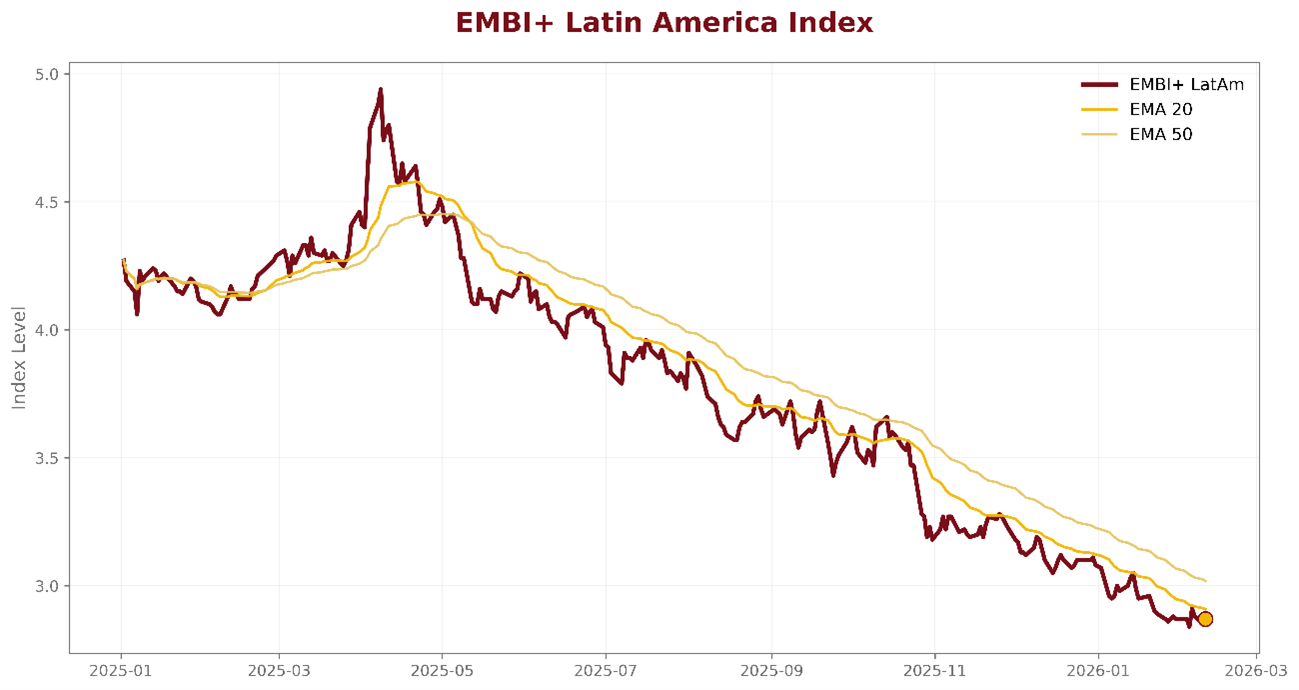
Investors may be confident that Latin America not only participated in the process of enhancing the stability of developing economies but also did so with greater strength. This relative performance indicates that capital flows see value in the region due to historically high returns and new signals of macroeconomic stability in certain countries.
The signal is easier to understand than the EMBI+. Latin America is superior to other emerging markets when considered in its entirety. This relative improvement indicates that the region is no longer perceived as a concern. It is perceived as a superior alternative due to its firmer foundations and higher risk premium, particularly during periods of increased capital allocation. This tendency indicates that there is a robust equilibrium between price appreciation and transfers from a strategic perspective. This implies that Latin America is an advantageous investment destination for global investors at present, as risk is being mitigated and the situation is becoming more stable.
The compression in 2025 and with a vision towards 2026 indicates that markets are no longer perceiving Latin America as being in a weak situation, but rather as a safe haven, far removed from global conflicts.
Latin America is no longer a question of whether it is a good location to invest; rather, the question is how many additional assets should be incorporated into the portfolio. The economy is currently experiencing rapid growth, and disregarding this warning could result in missing out on one of the most significant opportunities. This is supported by data from 2025.
Traditional sources of return are offering reduced rates, which is why Latin America is once again a significant contributor to increases in market allocations. This trend is not arbitrary exposure, but rather Sta meticulous combination of technical monitoring, fundamental analysis, and active risk management.
This opinion article was written on February 12, 2026, by the team of analysts at OTG Asset Management.